A Full Analysis, Sources and Methodology
A veteran’s account of what these decisions mean and what they prevented
By Squadron Leader Adefola Amoo (Rtd) I April 2026
To be clear, specific people and institutions in this administration have dealt with me in bad faith over my tech innovations within the context of promoting indigenous innovators. So did people and institutions in the previous administration. These travails of mine with government are well documented in the public domain from 2018 to date for reference; so, clearly, I am nobody’s lackey.
What my upbringing, my education, and my years of military service taught me is how to separate issues from people. That is what this article does.
This article you are reading now, is the technical companion to the general audience article published on this blog.
That article tells the full story of the four decisions by President Tinubu, the human impact, what our mornings would have looked like without these policies, and what every Nigerian would have had to stop doing by April 2026 due to unaffordability attributable to the Hormuz Strait situation. It is required reading before this article you are on. If you have not read it, then:
Read it first here: https://adefolaamoo.com/2026/04/07/four-decisions-the-reason-nigeria-did-not-collapse-in-2026/
Come back here when you want the numbers, the methodology, and the analytical framework behind the conclusions.
The Context in Four Sentences
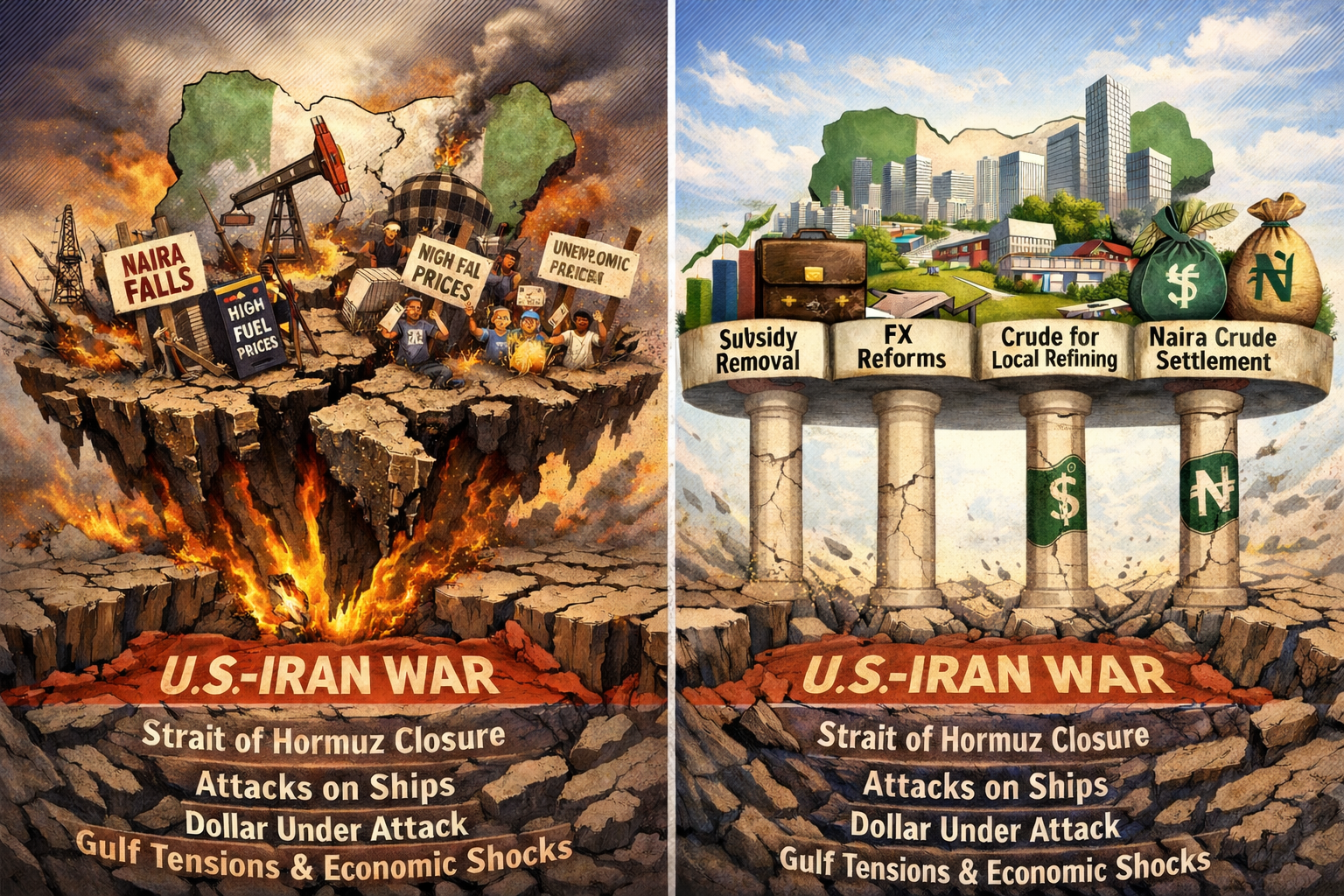
In February 2026, America and Israel struck Iran. The Strait of Hormuz closed. Brent crude surged to $120. The Nigerian economy which should have been devastated, was not. Four policy decisions made by President Tinubu between May 2023 and October 2024 are the reason why Nigeria’s economic devastation did not happen.
The Price Evidence
These are not projections. The “With Tinubu’s Policies” column is verified Nigerian market data
from March and April 2026. The “Without Tinubu’s Policies” column is a modelled counterfactual derived from Brent crude at $120 per barrel, an estimated parallel market exchange rate of ₦3,500-4,500 per dollar, historical black market premiums during the 2022 fuel scarcity, and standard Nigerian economic pass-through data. The methodology for each figure is explained in the technical sections below.
| # | Item | Without Tinubu’s Policies | With Tinubu’s Policies | Multiplier |
|---|---|---|---|---|
| 1 | Petrol (per litre) | ₦4,000–6,000 (black market — pumps empty) |
₦1,350–1,500 | 4–5x |
| 2 | Diesel (per litre) | ₦5,500–9,000 (black market) |
₦1,700–2,000 | 3–5x |
| 3 | Cooking gas — 12.5kg | ₦38,000–55,000 | ₦14,000–18,000 | 2.5–3x |
| ↑ Energy — the foundation of every price below | ||||
| 4 | Bus/keke fare — short trip | ₦1,500–2,500 | ₦400–700 | 3–5x |
| 5 | Private car — full tank (40L) | ₦160,000–240,000 | ₦54,000–60,000 | 3.5–5x |
| 6 | Ride-hail Lagos, 10km | ₦12,000–25,000 | ₦3,500–6,000 | 3–4x |
| ↑ Transport — every item below moves by road | ||||
| 7 | 50kg bag of rice | ₦180,000–250,000 | ₦80,000–110,000 | 2–2.5x |
| 8 | Beans (per kg) | ₦4,500–7,000 | ₦1,200–1,800 | 3–4x |
| 9 | Basket of tomatoes | ₦80,000–120,000 | ₦35,000–45,000 | 3x |
| 10 | Vegetable oil — 5 litres | ₦45,000–70,000 | ₦18,000–22,000 | 3x |
| 11 | Bread — large loaf | ₦3,500–5,500 | ₦1,500–2,000 | 3x |
| 12 | Eggs — crate of 30 | ₦9,000–14,000 | ₦5,000–6,000 | 2.5–3x |
| 13 | Chicken — 1kg frozen | ₦12,000–20,000 | ₦6,500–8,000 | 2.5–3x |
| ↑ Food — all prices downstream of fuel and transport | ||||
| 14 | Generator diesel — monthly (3-bed home, 6hrs/day) |
₦800,000–3,000,000 | ₦180,000–320,000 | 5–6x |
| 15 | US dollar — bank purchase | ₦3,500–4,500 (black market only) |
₦1,380–1,450 | 3x |
| 16 | Private school fees — per term | ₦6,000,000–12,000,000 | ₦2,000,000–4,000,000 | 3x |
| 17 | Flight — Lagos to Abuja | ₦450,000–800,000 | ₦120,000–200,000 | 4x |
| 18 | Bottled water — 1 crate (75cl) | ₦8,000–13,000 | ₦2,500–4,000 | 3x |
| 19 | Cement — 50kg bag | ₦16,000–18,000 | ₦11,000–12,000 | 1.5x |
| 20 | Imported smartphone — mid-tier | ₦750,000–1,200,000 | ₦250,000–450,000 | 3x |
The “Without Tinubu’s Policies” prices are calculated from Brent crude at $120 per barrel — the highest verified price recorded this year — an estimated black market exchange rate of ₦3,500–4,500 per dollar, historical black market premiums during the 2022 fuel scarcity, and verified Nigerian market data. They are estimates, but they are grounded estimates. The direction and scale are not in dispute.
The “Without Policies” prices are calculated from Brent crude at $120 per barrel – the highest verified price recorded this year – an estimated black market exchange rate of N3,500-4,500 per dollar, historical black market premiums during the 2022 fuel scarcity, and verified Nigerian market data. They are estimates, but they are grounded estimates. The direction and scale are not in dispute.
The Technical Analysis
I. The Fiscal Arithmetic of Catastrophe
The fuel subsidy had evolved to not merely being expensive. It had become structurally destabilising in a way that made any external shock an existential threat. The IMF, in its 2022 Article IV consultation, calculated Nigeria’s implicit fuel subsidy at 2.2% of GDP, which was approximately $10 billion, or N4.4 trillion at the prevailing 2022 exchange rate of approximately N440 per dollar.
The subsidy bill was a multiplicative function of three variables: global crude price, the naira-dollar exchange rate, and daily consumption volume. The counterfactual calculation is transparent and reproducible.
At Brent of $120, a parallel market rate ofN4,000 per dollar, and daily consumption at the pre-reform level of 60 million litres, the annual subsidy cost exceeds N38-52 trillion. Against a 2026 federal budget of N36 trillion, this is fiscal impossibility and not merely fiscal stress. The subsidy would have consumed between 105% and 145% of the entire budget.
The oil revenue paradox compounds this. At elevated Brent prices, Nigeria earns more dollars from crude exports. But every additional dollar earned would immediately be offset and exceeded by the larger subsidy bill that higher oil prices create, because the cost of importing refined products rises proportionally with crude. Under the old structure, Nigeria could not benefit from high oil prices. The subsidy neutralised every windfall entirely. The President’s reforms broke that structural trap and allowed Nigeria to actually capture the revenue benefit of the current crisis.
Key fiscal indicators – counterfactual versus actual
Key fiscal indicators — counterfactual versus actual
| Indicator | Without the Policies | With the Policies |
|---|---|---|
| Annual subsidy bill at $120 Brent | ₦38–52 trillion | Zero |
| Entire 2026 federal budget | ₦36 trillion | ₦36 trillion |
| Subsidy as % of budget | 105–145% | 0% |
| Net external reserves | Below $2 billion | $34 billion |
| Debt service ratio trend | Accelerating toward 100%+ | Declining toward 68% |
II. Exchange Rate Dynamics – Modelling the Counterfactual
In mid-2022, with net reserves of approximately $8 billion and a subsidy bill running at N448 billion per month, the parallel market reached N710 per dollar against a CBN official rate of N420. That is a spread of 69%. All three drivers of that spread which were, reserve adequacy, subsidy dollar demand, and capital account confidence, would have been maximally worse in the counterfactual 2026 scenario.
The modelled parallel rate ofN3,500-4,500 derives from the following chain. Subsidy dollar demand of $22-28 billion annually exhausts net reserves below $2 billion within six to nine months of crisis onset. At sub-$2 billion net reserves, the CBN loses capacity to defend the official rate. Confidence collapses. Capital flight accelerates. The parallel rate finds a new equilibrium reflecting the true scarcity of dollars in a market where government is consuming all available supply for fuel imports. The 2022 data point of N710 per dollar at $85 Brent and $8 billion net reserves scales directionally to N2,800-3,500 on conservative assumptions. The upper bound ofN4,500 reflects the additional panic premium that a Hormuz-level global crisis generates.
Actual April 2026 position: unified rate of Nl,380-1,450 per dollar. Net reserves of $34 billion – verified against IMF assessments, using a net calculation methodology that accounts for forward obligations and swap commitments. The gross figure of $50 billion is corroborated by CBN published data and the 51% All-Share Index rally of 2025, which reflects genuine foreign investor confidence.
Counterfactual versus actual — key indicators
| Indicator | Without the Policies | With the Policies |
|---|---|---|
| CBN official rate | ₦460–700 (artificially held) | ₦1,380–1,450 (market rate) |
| Parallel market rate | ₦3,500–4,500 | Unified — no parallel market |
| Net external reserves | Below $2 billion | $34 billion |
| Annual FX demand for fuel imports | $22–28 billion | $5–8 billion |
| Headline inflation (annual) | Estimated 75–120% | ~15% and declining |
| Petrol supply security | Near-total disruption | Stable — Dangote buffer |
| Sovereign default risk | Very high — Sri Lanka parallel | Moderate and manageable |
| Foreign portfolio investment | Zero | Recovering — NGX +51% in 2025 |
III. The Dangote Refinery as Structural Shock Absorber
The 2026 Hormuz crisis has validated the strategic rationale for domestic refining more
decisively than any peacetime analysis could. Nigeria’s pre-reform import dependency of 60-67 million litres per day created a vulnerability acceptable when global shipping was normal. The current crisis has fundamentally altered that calculus.
Tanker war-risk insurance has risen from 0.125% to 0.4% of hull value per transit. For a Very Large Crude Carrier at full capacity, this is an additional cost of approximately $250,000 per voyage. Major shipping lines have suspended Middle East routes. In this environment, a Nigeria importing 100% of its refined products would face not merely higher prices but actual supply collapse. The domestic refining buffer which is currently supplying approximately 50% of national fuel demand has meant that the supply shock is absorbed rather than transmitted. This is not a price story. It is an availability story.
The naira-crude arrangement adds a second layer of insulation by partially severing the link between the dollar exchange rate and the domestic fuel price. Under the naira-crude arrangement, the pricing chain runs from naira crude cost through naira refining margin to naira pump price. The dollar rate is relevant only at the margin of the remaining imported portion.
This structural partial de-dollarisation explains why Nigeria’s petrol, at $0.88 per litre, stands 33% below the global average of $1.32 and below every major peer market; this is without any subsidy.
Nigeria versus peer markets — pump price per litre (April 2026)
| Country | Price per litre | vs Nigeria |
|---|---|---|
| Nigeria | $0.88 | Baseline |
| United States | $1.07 | +22% higher |
| India | $1.10 | +25% higher |
| South Africa | $1.19 | +35% higher |
| Global average | $1.32 | +50% higher |
IV. Inflation Transmission – Why the Disinflation Held
Nigeria’s headline inflation declined for eleven consecutive months to approximately 15% in early 2026. A note of transparency is required here.
The National Bureau of Statistics revised its inflation calculation methodology in late 2025, shifting the base year from 2009 to 2024 and changing the reference period. Under the previous methodology, December 2025 inflation would have been reported at approximately 31% rather than 15%. The NBS and international statistical reviewers have confirmed the revision is consistent with international best practice, correcting a known bias in the previous base-year approach.
Even accepting the higher figure of 31%, the disinflation trajectory is significant. It is down from
34.8% at the 2024 peak. And the counterfactual comparison survives entirely. 31% actual versus an estimated 75-120% counterfactual is a categorical difference, not a marginal one.
The counterfactual inflation range derives from empirical fuel-to-consumer price pass-through coefficients of0.7 to 1.2 for Nigeria, as established in CBN Research Department work and studies published in Energy Research Letters. Applied to a counterfactual fuel price shock of
300-400% above actual levels, even the lower bound coefficient of 0.7 produces implied inflation well above 200%. The conclusion is robust to significant downward revision of either input.
The actual disinflation is anchored by three reform linked structural changes. First, naira stability post unification reduces import cost volatility and breaks the depreciation/inflation feedback loop. Second, the Dangote refinery moderates domestic diesel prices, breaking the wholesale energy-to-food transmission chain that historically drove Nigeria’s food inflation. Third, fiscal consolidation freed the CBN to genuinely tighten the Monetary Policy Rate, which reached 27.5%; one of the highest real rates globally in 2025. Food inflation fell to 8.89% in January 2026, which is the first single-digit reading since May 2015.
Inflation — counterfactual versus actual
| Measure | Without the Policies | With the Policies |
|---|---|---|
| Headline inflation (annual) | Estimated 75–120% | ~15% (declining 11 months) |
| Food inflation | Estimated 150%+ | 8.89% in January 2026 |
| Peak fuel price shock | 300–400% above actual | 35–40% above pre-crisis |
| Pass-through to consumer prices | Full and immediate | Partially insulated |
| CBN monetary policy room | Zero — monetising deficit | MPR at 27.5% — genuine tightening |
V. Sovereign Risk – The Sri Lanka Parallel and What Was Avoided
The counterfactual Nigeria of April 2026 maps closely to Sri Lanka at the point of its 2022 sovereign default. The profile is identical: a large subsidised energy bill consuming fiscal space; rapidly dwindling reserves; a maintained official exchange rate divorced from reality; rising import costs; and an exogenous commodity shock as the precipitating event. Sri Lanka’s net reserves fell below $100 million before its forced IMF programme. Inflation reached 70%.
Citizens queued for fuel and cooking gas for months.
Nigeria’s counterfactual reserve position where there is only below $2 billion net, with a subsidy bill exceeding the entire budget replicates that profile precisely. The IMF programme that would have been forced on Nigeria would have carried identical conditionalities to what President Tinubu enacted voluntarily in 2023. The difference is fundamental. Voluntary reform executed proactively, with reserves sufficient to manage the transition, is categorically different from forced reform executed in crisis, with no buffer, under IMF conditionality, and with a population already in distress. The outcomes of nominally identical policies are radically different depending on whether they are chosen or imposed.
Nigeria counterfactual versus Sri Lanka 2022 — the parallel
| Indicator | Sri Lanka 2022 (actual collapse) | Nigeria 2026 (counterfactual) |
|---|---|---|
| Net external reserves | Below $100 million | Below $2 billion |
| Subsidy bill vs budget | Consumed fiscal space entirely | Would have exceeded entire budget |
| Official vs parallel FX rate | Extreme divergence | Extreme divergence |
| Inflation at peak | 70% | Estimated 75–120% |
| IMF programme | Forced — under duress | Would have been forced |
| Fuel and food queues | Nationwide for months | Near certain |
| Outcome | Sovereign default | Avoided by the four decisions |
What This Is Not
This is not a claim that Nigerians are comfortable. Millions are struggling. The transition cost of these reforms fell very hard on everyone. That is a legitimate pain and reality.
This is neither a claim that Dangote’s market position is without risk. A single private refinery supplying half a nation’s fuel needs raises long-term competition questions that deserve their own serious analysis. Nigeria needs more privately built, managed and operated refineries.
What is this then? It is a fact-backed, honest account of four specific decisions that saved Nigeria, Nigerians and our economy as a State during the worst global energy crisis in half a century. A crisis which would have left the greater majority of us in the worst possible economic crisis that we have ever seen. Thankfully, that’s not the case.
In the simplest terms: an earthquake happened. Beautiful houses are crashing, collapsing and burning. But the house that President Tinubu built shook but it is still standing. That is because he ensured that the structural pillars (the macroeconomic principles) that would hold us safe were already in place.
The earthquake came. The Nigerian economy is still standing. We are not all starving, queueing for days without hope of seeing fuel, not carrying our money in wheelbarrows to buy a loaf of bread, not weeping to see our children dying because there are no medications, unable to fly abroad to escape because tickets cost a home. That is all because of President Tinubu’s four decisions when no one knew that the Hormuz crisis was coming.
Squadron Leader Adefola Amoo (Rtd) is a Nigerian Air Force veteran. He has served at the Presidency, Air Force Headquarters, federal ministries and agencies, and at state government level. He writes on governance, public policy, technology and security.
Read the general audience version of this analysis at adefolaamoo.com https://adefolaamoo.com/2026/04/07/four-decisions-the-reason-nigeria-did-not-collapse-in-2026/
Sources & References
Reuters (January 2023) — Nigeria’s NNPC spent $10 billion on fuel subsidy in 2022
IMF Nigeria 2022 Article IV Consultation — Fuel subsidies at 2.2% of GDP; exchange rate and fiscal analysis
BudgIT — Economic Sensitivity of Petrol Subsidy Removal (2023) — Subsidy cost projections and budget impact analysis
GlobalPetrolPrices.com — Nigeria Gasoline Prices (March 2026) — Verified pump price data and international comparisons
S&P Global Commodity Insights — Nigeria FX market, fuel import data and IMF subsidy assessment
Federal Reserve Bank of Dallas Research (March 2026) — Quantifying global GDP impact of Strait of Hormuz closure
Wikipedia — 2026 Strait of Hormuz Crisis — Timeline, oil price data, tanker insurance, shipping disruptions
IMF Nigeria 2025 Article IV Mission Statement — Reserve accumulation, reform assessment, macroeconomic outlook
Trading Economics — Nigeria CPI and Inflation Series — Monthly inflation data including NBS methodology revision disclosure
Punch Nigeria — The Naira’s Tumultuous Trajectory (2026) — Exchange rate history, reserve recovery, CBN policy analysis
Legit.ng — Nigeria Food Inflation Hits 10-Year Low (February 2026) — NBS food price data, January–February 2026
Nairametrics — Nigeria Faces Price Surge (April 2026) — Impact of Hormuz crisis on Nigerian consumer prices
Tribune Online — Fuel Crisis Fuels Inflation (March 2026) — Market price data, transport costs, food price survey
Aproko247 — How Dangote Refinery Keeps Nigeria’s Petrol Prices Among World’s Lowest (March 2026) — Dangote refinery supply data, domestic production volumes
Intelpoint — Nigeria Daily Fuel Consumption Post Subsidy Removal — Pre and post-reform consumption data; Dangote refinery operational volumes
IG International — Strait of Hormuz Closure: Implications for Asia (March 2026) — Oil price analysis, Brent futures, tanker insurance data
Goldman Sachs — How Will the Iran Conflict Impact Oil Prices (March 2026) — Oil price scenario modelling; risk premium analysis
Bloomberg — Iran War: Hormuz Closure Oil Shock (2026) — Global oil market analysis; price trajectory scenarios
Wikipedia — Economic Impact of the 2026 Iran War — Comprehensive data on global economic disruption from the Hormuz closure
© April 2026 — Squadron Leader Adefola Amoo (Rtd). Reproduction permitted with full attribution and a link to the original.
© April 2026 – Squadron Leader Adefola Amoo (Rtd). Reproduction permitted with full attribution and a link to the original.
2 responses to “Four Decisions. The Reason Nigeria’s Economy Did Not Collapse in 2026 – The Technical Case.”
-
[…] For the full technical analysis, sources, and methodology behind this article, read the companion piece here: https://adefolaamoo.com/2026/04/07/four-decisions-the-reason-nigerias-economy-did-not-collapse-in-20… […]
-
[…] Four Decisions. The Reason Nigeria Did Not Collapse in 2026 — The Technical Case https://adefolaamoo.com/2026/04/07/four-decisions-the-reason-nigerias-economy-did-not-collapse-in-20… […]
Leave a Reply