A veteran’s account of what these decisions mean and what they prevented
By Squadron Leader Adefola Amoo (Rtd)
To be clear, specific people and institutions in this administration have dealt with me in bad faith over my tech innovations within the context of promoting indigenous innovators. So did people and institutions in the previous administration. These travails of mine with government are well documented in the public domain from 2018 to date for reference; so, clearly, I am nobody’s lackey.
What my upbringing, my education, and my years of military service taught me is how to separate issues from people. That is what this article does.
The Point
Nigeria like the rest of the world, is in the middle of a global oil crisis. A shock to the system, an unexpected economic earthquake that tests the foundation of the economy we all depend on daily. The worst since the 1970s. Fuel prices worldwide have gone through the roof. Countries are rationing. Governments are panicking.
Nigeria, not so much; not as bad as it very nearly would have been.
Our filling stations have fuel today. Expensive, but it is there. Our naira has not collapsed into freefall. Our government has not run out of money. That is not luck. That is the direct result of four policy decisions and one refinery.
This table shows the price of 20 common things in Nigeria today, and what those same things would have cost in the post “Hormuz closure” April 2026, if those decisions had not been made. Everything that follows explains why.
Price Comparison Table: April 2026
“Without Tinubu’s Policies”= what prices would be today under the old subsidy system, with no domestic refinery supply, and with the old dual exchange rate – during the current global oil crisis.
“With Tinubu’s Policies”= verified Nigerian market prices, April 2026.
| # | Item | Without Tinubu’s Policies | With Tinubu’s Policies | Multiplier |
|---|---|---|---|---|
| 1 | Petrol (per litre) | ₦4,000–6,000 (black market — pumps empty) |
₦1,350–1,500 | 4–5x |
| 2 | Diesel (per litre) | ₦5,500–9,000 (black market) |
₦1,700–2,000 | 3–5x |
| 3 | Cooking gas — 12.5kg | ₦38,000–55,000 | ₦14,000–18,000 | 2.5–3x |
| ↑ Energy — the foundation of every price below | ||||
| 4 | Bus/keke fare — short trip | ₦1,500–2,500 | ₦400–700 | 3–5x |
| 5 | Private car — full tank (40L) | ₦160,000–240,000 | ₦54,000–60,000 | 3.5–5x |
| 6 | Ride-hail Lagos, 10km | ₦12,000–25,000 | ₦3,500–6,000 | 3–4x |
| ↑ Transport — every item below moves by road | ||||
| 7 | 50kg bag of rice | ₦180,000–250,000 | ₦80,000–110,000 | 2–2.5x |
| 8 | Beans (per kg) | ₦4,500–7,000 | ₦1,200–1,800 | 3–4x |
| 9 | Basket of tomatoes | ₦80,000–120,000 | ₦35,000–45,000 | 3x |
| 10 | Vegetable oil — 5 litres | ₦45,000–70,000 | ₦18,000–22,000 | 3x |
| 11 | Bread — large loaf | ₦3,500–5,500 | ₦1,500–2,000 | 3x |
| 12 | Eggs — crate of 30 | ₦9,000–14,000 | ₦5,000–6,000 | 2.5–3x |
| 13 | Chicken — 1kg frozen | ₦12,000–20,000 | ₦6,500–8,000 | 2.5–3x |
| ↑ Food — all prices downstream of fuel and transport | ||||
| 14 | Generator diesel — monthly (3-bed home, 6hrs/day) |
₦800,000–3,000,000 | ₦180,000–320,000 | 5–6x |
| 15 | US dollar — bank purchase | ₦3,500–4,500 (black market only) |
₦1,380–1,450 | 3x |
| 16 | Private school fees — per term | ₦6,000,000–12,000,000 | ₦2,000,000–4,000,000 | 3x |
| 17 | Flight — Lagos to Abuja | ₦450,000–800,000 | ₦120,000–200,000 | 4x |
| 18 | Bottled water — 1 crate (75cl) | ₦8,000–13,000 | ₦2,500–4,000 | 3x |
| 19 | Cement — 50kg bag | ₦16,000–18,000 | ₦11,000–12,000 | 1.5x |
| 20 | Imported smartphone — mid-tier | ₦750,000–1,200,000 | ₦250,000–450,000 | 3x |
The “Without Tinubu’s Policies” prices are calculated from Brent crude at $120 per barrel — the highest verified price recorded this year — an estimated black market exchange rate of ₦3,500–4,500 per dollar, historical black market premiums during the 2022 fuel scarcity, and verified Nigerian market data. They are estimates, but they are grounded estimates. The direction and scale are not in dispute.
The “Without Tinubu Policies” prices are calculated from Brent crude at $120 per barrel, an estimated black market exchange rate of ₦3,500-4,500 per dollar, historical black market premiums during the2022 fuel scarcity, and standard Nigerian economic data. They are estimates, but they are grounded estimates. The direction and scale are not in dispute.
What Happened to the World
In February 2026, America and Israel struck Iran. The Strait of Hormuz -the waterway carrying one-fifth of the world’s oil- closed. Brent crude surged to $120 a barrel. The world had not seen an energy shock like this since the 1970s.
Every country that depends on imported fuel felt it immediately. Nigeria should have felt it most. We did not. Here is why.
The Four Decisions
Decision One: Subsidy Removal – May 29, 2023
Nigeria was spending ₦4.4 trillion a year subsidising petrol. Every litre imported cost the government far more than Nigerians paid at the pump. The government quietly absorbed the difference. By 2022 that bill consumed virtually everything Nigeria earned from oil.
Tinubu ended it on Day One.
The pain was immediate and real. Transport fares doubled overnight. Food prices followed. For millions of Nigerians at the bottom, it was not a policy adjustment. It was a crisis arriving at their door without warning. That cost was real and it must be said plainly.
But ask the question the other way. At today’s oil price of $120 a barrel, what would that subsidy bill be? The answer is between ₦38 trillion and ₦52 trillion per year. The entire Nigerian budget for 2026 is ₦36 trillion. The subsidy alone would have exceeded everything the government spends on everything. There would have been nothing left. No salaries. No hospitals. No military. Nothing.
That is what was prevented.
Decision Two: One Exchange Rate – June 2023
Before this decision, Nigeria had two dollar prices. A cheap official rate for those with access. An expensive black market rate for everyone else.
Nigeria imported virtually all of its refined fuel — and fuel imports are paid in dollars. Under the dual rate system, NNPC sourced those dollars at the official rate. That rate was fictional. It was only available because the CBN was burning through reserves to defend it. Those reserves were running out. The collapse was coming regardless. What the Hormuz crisis did was guarantee it would arrive violently, without warning, and without a plan.
Every fuel import would have repriced overnight at the panic black market rate. Every truck on every Nigerian road runs on diesel. Every generator. Every factory, every bakery, every cold store, every hospital. All of it simultaneously repriced in a collapsing currency. The cascade into transport costs, food prices and manufacturing costs would have been instantaneous and total.
President Tinubu floated the naira. One market. One price. The naira fell sharply and that was painful. But it was a blessing in disguise. It would seem the President saw what was coming. When the Hormuz earthquake struck in February 2026, there was no fictional rate to defend, no reserves to burn, no gap between reality and policy for the crisis to exploit. Foreign investors returned. Nigeria’s external reserves rose from $3.9 billion net when Tinubu took office to over $34 billion net by early 2026.
Without this decision, the line to catastrophe is straight and short.
High dollar rate. No dollars available. Fuel imports priced at ₦3,500 to ₦4,500 per dollar. No fuel arriving. Empty filling stations. No diesel for trucks. Food stranded on farms. Factories silent. Hospital generators dark. Every business, every school, every market repriced overnight at a rate that makes normal life impossible.
It does not stop gradually. It stops all at once.
That is not speculation. That is the arithmetic of a country that imported 100% of its refined fuel, with no reserves left, trying to buy dollars at ₦4,000 each in the middle of the worst oil crisis in fifty years.
The exchange rate unification did not just save the naira. It saved the supply chain. It saved the economy. It saved our country.
Decision Three: Give the Refinery Nigerian Crude – Late 2024
Dangote built the refinery. Let that be clear. $20 billion of private capital. Constructed before Tinubu. Licensed before Tinubu.
But a brand new refinery in Nigeria importing crude was an aberration.
At the time, Nigeria was exporting virtually all its crude internationally. Dangote refinery was wrangling with “the System” to get access to Nigerian Crude in Nigeria. Tinubu’s administration went ahead and directed NNPC to supply Nigerian crude to the Dangote refinery as a domestic priority. This was not automatic. Previous administration had the same refinery available and did not make this call with the same decisiveness.
By December 2024 the refinery was producing 350,000 barrels of refined fuel per day. By early 2026 it was supplying roughly half of Nigeria’s domestic fuel needs.
Today, with the Hormuz closed and international tankers unable to move freely, that domestic supply is the reason your filling station is not empty. The product does not need to come through a war zone. It is made here.
Decision Four: Pay for the Crude in Naira – October 2024
This is the quietest of the four decisions. It is also the most elegant.
When Dangote bought crude from NNPC in dollars, the dollar cost passed through directly to our pump price. Every time the naira weakened, petrol got more expensive. The connection between the dollar rate and our fuel bill was direct and unavoidable.
The government directed that domestic crude be settled in naira. The dollar chain was broken – at least for the locally refined portion. Dangote pays NNPC in naira. Refines in naira. Prices in naira.
The result is visible right now. Nigeria’s petrol costs $0.88 per litre. The global average is $1.32. America pays $1.07. India pays $1.10. South Africa pays $1.19. Nigeria however, in the middle of the worst oil crisis in fifty years has some of the lowest fuel prices on earth. Without a subsidy.
That is what the naira-crude arrangement did.
Your Morning, Without These Decisions
Here is a picture of your morning today but without President Tinubu’s four decisions:
The filling station near you has been empty for eleven days. Black market petrol is ₦5,000 a litre and rising. Your generator diesel costs ₦7,000 a litre on the street. Running your generator for six hours a day costs ₦105,000. Per month that is over ₦3,000,000, you cannot run your generator even if your salary is ₦800,000.
So, you cannot run your generator. You have no power.
Your bank cannot give you dollars at any official rate. The CBN has none. Every dollar in the
system is being consumed by NNPC trying to import fuel that the tankers cannot deliver anyway. You are upper upper middle class, your child’s school fees is dollar-invoiced and it is now effectively ₦8,000,000 at the black market rate. They were ₦2,000,000 last term. The middle class would have crashed face down into the “upcoming” class.
For those whose government did not remove subsidy, your government cannot pay salaries. The federation account would be empty because the subsidy consumed everything. States are three months behind. Teachers are not in schools. The IMF is on the phone with conditions.
This is not imagination. This is the arithmetic. This is what the data says would have happened.
What You Would Have Had To Stop Doing
That morning described above is not the whole picture. Here is the fuller list of what every Nigerian would have had to stop doing by April 2026 due to unaffordability attributable to the Hormuz Strait situation, without the four decision of President Tinubu:
- Building or finishing your house. Finishings, fittings, tiles, paint and other building materials are either imported or have imported components. At ₦4,000 to the dollar your building materials would have doubled or tripled overnight. Most construction sites in Nigeria would have gone silent.
- Restocking your shop or business. Every trader who imports goods, be it electronics, fabrics, provisions, spare parts actually pays in dollars. No affordable dollars means empty shelves and no new stock.
- Sending your child to school. Private school fees are dollar-referenced. At the crisis rate a ₦2,000,000 term fee becomes ₦6,000,000 to ₦8,000,000. It would have meant that most middle-class families would have pulled their children out.
- Fuelling your generator. Diesel at ₦7,000 per litre on the black market makes running a generator unaffordable for all but the wealthiest. You would have chosen between light and food.
- Running your business. No diesel means no power. No power means no production. No production means no income. Small and medium businesses which are the backbone of the Nigerian economy would have been the first casualties.
- Travelling by air domestically. Aviation fuel is dollar-priced. A Lagos to Abuja ticket at ₦600,000 to ₦800,000 would have grounded most domestic travel. Business trips, family visits, medical travel would have all been suspended.
- Paying your staff. State governments with empty FAAC allocations would have stopped paying civil servants. Private businesses unable to operate would have followed. Mass unemployment in weeks, not months.
- Buying your regular medications. Most pharmaceutical inputs are imported. At a collapsed exchange rate, drug prices would have become unaffordable for ordinary Nigerians. Managing hypertension, diabetes and asthma would have become a luxury.
- Eating protein daily. Frozen chicken, fish and eggs depend on cold chains that run on diesel. Diesel scarcity would have made cold chain logistics uneconomical. Protein would have disappeared from the average Nigerian table.
- Moving goods from farm to market. Truck drivers cannot move food if diesel costs ₦7,000 a litre. Farm produce would have rotted at source while urban markets ran empty. Food scarcity on top of fuel scarcity.
- Receiving your salary on time. With the federation account consumed by a subsidy bill exceeding the entire national budget, states would have gone three to six months without paying workers. Teachers, nurses, local government staff would have been left unpayable.
- Accessing your dollars at the bank. The CBN would have had no dollars to allocate. Official FX windows would have closed or been rationed to strategic imports only. Every personal dollar need school fees abroad, medical treatment, travel could only have been met on the black market at ₦4,000 plus.
- Fixing or replacing your car. Imported spare parts, which is most spare parts in Nigeria, would have repriced at the crisis exchange rate. A routine repair becomes a major financial decision. Most Nigerians would have parked their cars.
- Investing in anything. No serious investor be it local or foreign would commit capital in an economy where the exchange rate is in freefall, fuel is unavailable, and the government cannot meet its obligations. The stock market, real estate and business expansion would have frozen.
- Trusting that tomorrow will be manageable. This is the one that does not appear in any economic model but is felt by every Nigerian. The psychological cost of a society where fuel price, exchange rate and salary payment are all uncertain simultaneously destroys planning, saving and hope. That cost is real even when it is invisible.
What This Is Not
This is not a claim that Nigerians are comfortable. Millions are not. The transition cost of these reforms fell very hard on everyone, that is a legitimate pain and reality.
This is neither a claim that Dangote’s market position is without risk. A single private refinery supplying half a nation’s fuel needs raises long-term competition questions that deserve their own serious analysis. Nigeria needs more privately built, managed and operated refineries.
What is this then? It is a fact-backed, honest account of four specific decisions that saved Nigeria, Nigerians and our economy as a State during the worst global energy crisis in half a century which would have left the greater majority of us in the worst possible economic crisis that we have ever seen.
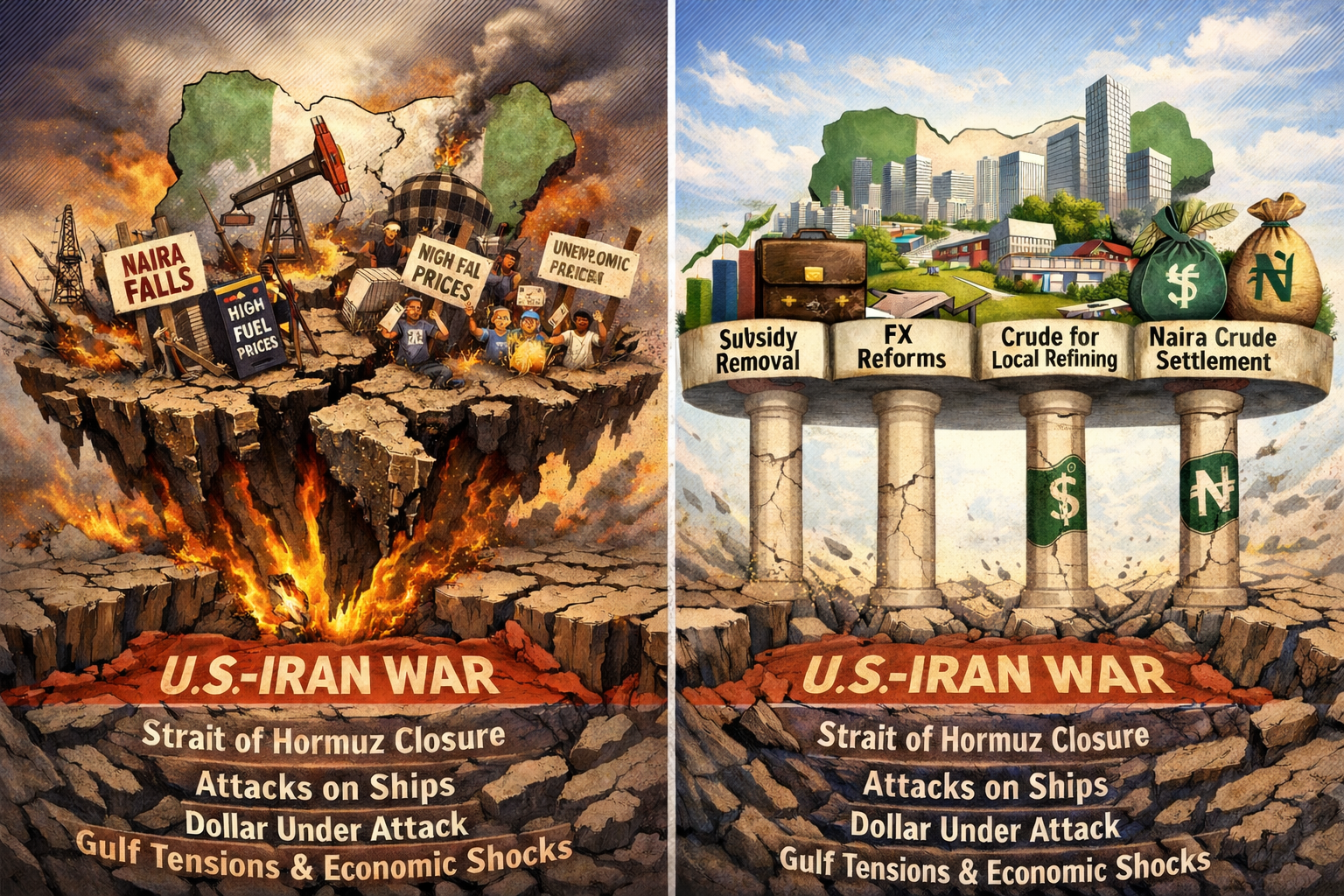
In the simplest terms, an earthquake happened, beautiful houses are crashing, collapsing and burning but the house that President Tinubu built shook, but it is still standing. That’s because he ensured that the structural pillars (meaning…. macro-economic principles) that would hold of us were already in place.
The earthquake came. The Nigerian economy is still standing and its because of President Tinubu’s four decisions.
Squadron Leader Adefola Amoo (Rtd) is a Nigerian Air Force veteran who has served at the Presidency, Air Force Headquarters, federal ministries and agencies, and at state government level. He writes on governance, public policy, technology and security.
For the full technical analysis, sources, and methodology behind this article, read the companion piece here: https://adefolaamoo.com/2026/04/07/four-decisions-the-reason-nigerias-economy-did-not-collapse-in-2026/
© April 2026 – Squadron Leader Adefola Amoo (Rtd). Reproduction permitted with full attribution and a link to the original.


Leave a Reply